Market Segmentation: An Important Aspect Of The Sales Process
What Is Market Segmentation?
To better understand market segmentation, let us look at this scenario: When trying to reach
customers or clients with your marketing message or ad campaign, targeting the right market
with the right message is very essential because, if you aim too broadly, your message might
reach a few people who end up becoming customers, but you’ll also reach a lot of people who
are not interested in your products or services. When your message is not optimized for your
target audience, you’ll end up with a lot of wasted advertising resources.
Market segmentation can help you to target just the people most likely to become satisfied
customers of your company’s products and services or enthusiastic consumers of your content.
To break a market into segments, you split it up into groups that have similar characteristics.
You can base a segment on one or more of these qualities. By splitting up your audience in
this way allows for more precise targeted marketing activity and personalized content creation.
The Importance of Market Segmentation
Market segmentation can help you to define and better understand your target audience
and ideal customers. If you’re a marketer, this will allow you to identify the right market for
your products or services and then target your marketing message more effectively.
Similarly, publishers can use market segmentation to offer more targeted advertising options
for the products, they are marketing and it will also allow them to customize their content for
different audiences or groups.
For example, you’re a marketer who’s advertising a new brand of dress. You could split an
audience into segments based on the type of dress, either for winter or summer, and the
audience could be segmented into female or male. You could then segment that audience
further based on if the dresses are for adults or children. A publisher could use this same
information to show content about fashion to people who are looking to buy or own a clothing store.
Market segmentation allows you to target your content to the right people in the right way,
rather than targeting your entire audience with a generic, focus-less message.
This increases the likelihood of someone engaging with your ad or content, leading to
more efficient campaigns and a higher return on investment (ROI).
Types of Market Segmentation
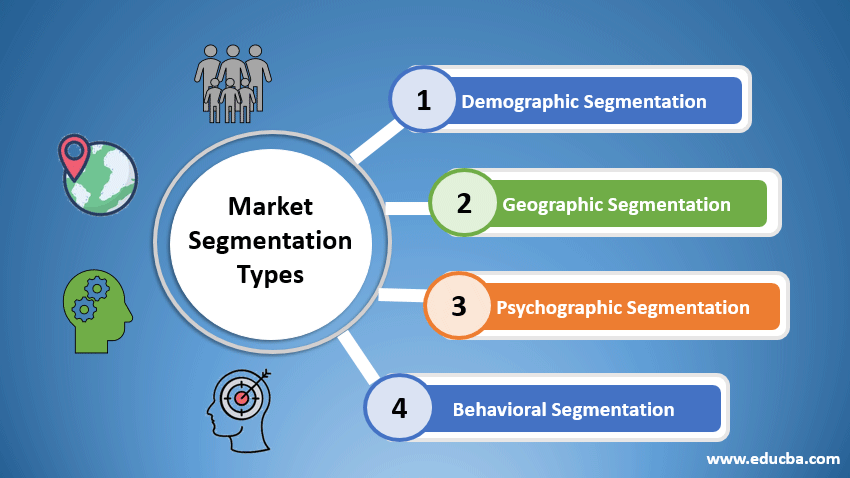
There are different kinds of market segments you can create. Below are the four main
methods of market segmentation. It is possible to create more niche segments
within the types below.
1. Demographic Segmentation
Demographic segmentation is one of the most common types of segmentation.
It refers to dividing audiences based on observable information and people-based differences.
These qualities include things like age, sex, marital status, family size, occupation,
education level, income, race, nationality, location, religion, etc.
Segmenting a market according to demographics is the most basic form of segmentation.
Combining demographic segmentation with other types can help you narrow down your
market even more. One benefit of this kind of segmentation is that the information is easy
to access and low-cost to obtain.
Some products are targeted explicitly at a specific demographic. One personal care company,
for example, might make two deodorant products—one labeled as men’s deodorant and one
labeled as women’s deodorant.
Automotive companies often segment their audience by income and market different makes
and models of cars to each segment. One company may have a luxury brand, an economy
brand, and a mid-range brand.
There are numerous ways to gather demographic data. One way is to ask your
customers directly. This can be time-consuming, but getting the information directly
from customers will help ensure its accuracy. If you go this route, be careful to be
respectful in how you ask and give customers sufficient response options so you get
accurate results. We can also obtain demographic data directly from customers by looking
at their social media profiles, where they may have provided information about themselves.
2. Behavioural Segmentation
You can also divide your market into segments based on consumers’ behaviuors or purchasing
patterns online, especially regarding your product or service. Dividing your audience based
on the behaviours they display allows you to create messaging that caters to those behaviors.
The actions you might look out for are the ones relating to how someone interacts with your
product, website, app, or brand.
Some types of behaviors to look at include:
- Online shopping habits: Consider a user’s online shopping habits across all sites, as this may give you a clue as to the fact that they might make an online purchase on your website.
- Actions taken on a website: You can track actions users take on your online properties to better understand how they interact with them. You might look at how long someone stays on your site, whether they read articles all the way to the end, the types of content they click on if they add products to their cart, and more.
- Benefits sought: This refers to the need a customer is trying to meet by purchasing a product, which is also referred to as their pain points.
- Usage rate: You can categorize users based on usage rate. Your marketing message will be different depending on whether someone is a heavy user, medium user, light user or non-user of your product.
- Loyalty: After using a product for some time, customers often develop brand loyalty. You can categorize customers based on how loyal they are to your brand and tailor your marketing messages accordingly.
Finally, behavioural data is useful because it relates directly to how someone interacts with
your brand or products. Because of this, it can help you market more effectively to them.
Marketers can collect this data through various means, such as the cookies placed on websites,
the purchase data in a company’s customer relationship management (CRM) software, and or
third-party databases.
3. Geographic Segmentation
Geographic segmentation, or splitting up your targeted audience and market based on their
location, is a basic but highly useful segmentation strategy. A customer’s location can help you
better understand their needs and enable you to send out location-specific advertisements.
There are several kinds of geographic segmentation, but the most basic among them is
identifying users based on their locations, such as their country, state, county, and zip/postal code.
Marketers can also identify consumers based on the characteristics of the area they live in,
such as its climate, population density, and whether it’s urban, suburban, or rural.
Identifying characteristics can require you to get more specific since one county could have rural,
suburban, and urban areas.
Dividing a market according to location is critical if you need to target an ad to people in a
specific area, such as if you’re advertising a small local business. It can also be useful
if you’re targeting a broad area because it allows you to tailor your ads according to regional
differences in language, interests, norms, and other attributes, as well as the differing
needs of people in different regions.
You may need to change the language of your marketing message depending on the
region or location you’re targeting.
People who live in different countries may also have different interests. For example,
baseball is very popular in the United States, while cricket is more popular in India and
football is common in the UK and Europe. If you’re marketing sports equipment or
publishing sports articles, you will want to take these different preferences into consideration.
Companies can also consider different needs in different regions. For instance,
a clothing company might show ads featuring warmer clothing to people living in
cold areas and the opposite to people living in warmer or hot regions.
4. Psychographic Segmentation
Psychographic segmentation is similar to demographic segmentation, but it deals
with characteristics that are more mental and emotional. These attributes may not
be as easy to observe as demographics, but they can give you valuable insight into
your audience’s motives, preferences, and needs.
If you as a marketer understand the psychographic attributes of your audience,
it can help you create content that appeals to them personally. Some examples of
psychographic characteristics include personality traits, interests, beliefs, values,
attitudes, and lifestyles.
If you find that members of a demographic segment are responding differently
to your content, you might want to add some psychographic information.
While demographics provide the basic facts about who your audience is,
psychographics gives you insight into why your targeted audience decides to
purchase or not purchase your product, clicks on or ignore your ads, and
otherwise interacts with your content.
For example, you’re a furniture and home decor company, and you have a market
segment consisting of newlyweds in their 20s and 30s with a household income of
over $60,000. Some members of this segment are converting, while others are not.
When you add psychographic information into the mix, you may find that people that
purchase your products often value community and friendships and are
environmentally conscious. Based on this information, you could create ads that show
people entertaining friends in their homes and emphasize the environmentally
friendly attributes of your brand.
You can gather this data in many of the same ways you can gather demographic data.
You can ask your existing customers for this information using surveys. Marketers can also
look at the way people interact with your website and see what types of content they
engage with, which gives you insight into their interests and preferences.
People can also supplement their first-party data with second-party and third-party data.
Other Methods of Market Segmentation
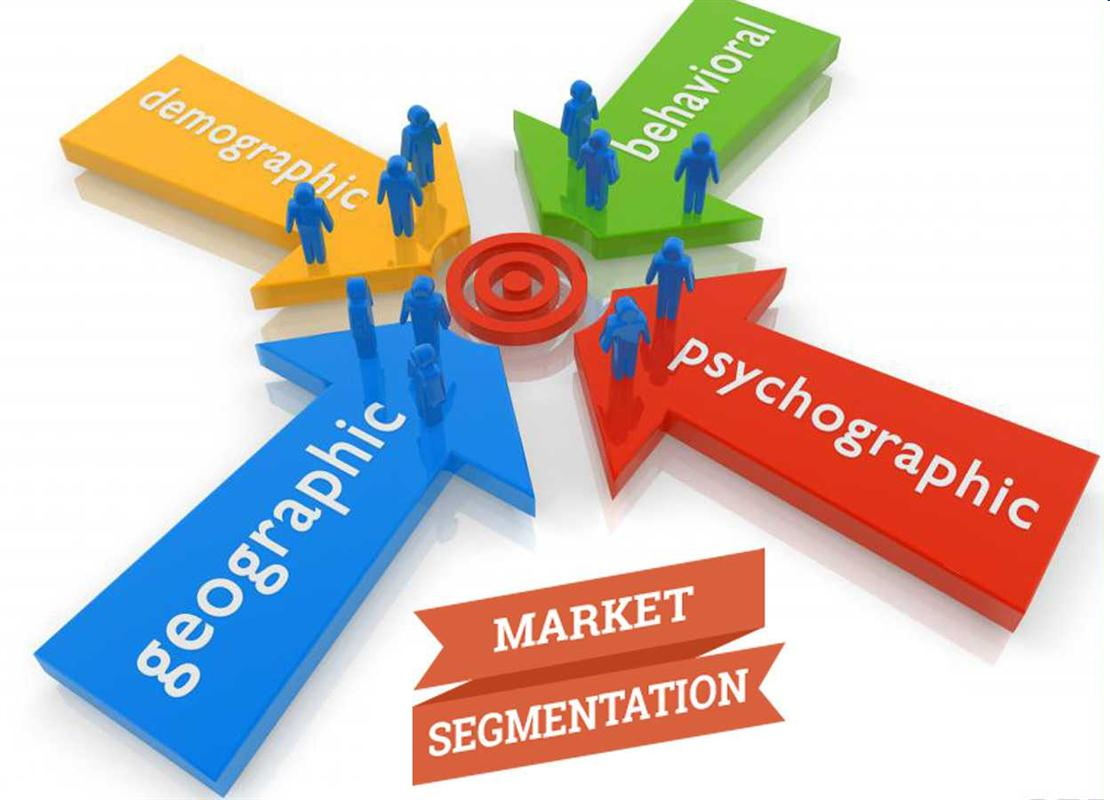
Demographic, behavioural, psychographic, and geographic segmentation are considered
the four main types of market segmentation, but there are also many other strategies you
can employ to target your ads toward your intended audience. This includes numerous
variations on the four main types. Here are several more methods you may want to look into.
- Value segmentation: Some businesses will split up a market based on the “transactional worth” of their customers and clients — how much they’re likely or willing to spend on their products and services. To determine a customer’s transactional worth, you can look at previous purchase data such as how many purchases they make, how often they make purchases, and the value of the items they purchase.
- Firmographic segmentation: This is the classification of business-to-business customers based on shared company or organization attributes. Business-to-business (B2B) companies may use firmographic segmentation to divide up the businesses in a market. This is similar to demographic segmentation with individual consumers but instead looks at the characteristics of companies that may become customers. Examples of data to look at include industry, revenue, number of employees, and location.
- Lifestage segmentation: You can also segment your market into groups based on where they are in their lives. Going to college, getting married, changing jobs, and having children are examples of key life events to consider. People at different stages of life need different things. For instance, soon-to-be college students may need apartment furniture. New parents will be looking to purchase baby items etc.
There are other types of market segmentation that are equally important, like seasonal
segmentation and behavioral segmentation. As you may have come to understand,
marketing is an important aspect of any business, both online and offline, and so if
not done well, it can maim your business permanently. We at Retink have dedicated
our time and resources to handle that important aspect for you so that you can have
such an important area handled by professionals. Get in touch with us today for your
marketing needs.
Market Segmentation: An Important Aspect Of The Sales Process Read More »