Solomon Eko

He is a trained journalist from the Deutsche Welle Akademie Bonn and earned a Master's degree in International Media Studies from the Hochschule Bonn Rhein-Sieg and the University of Bonn. Solomon has done and tried many things, from an aspiring professional footballer to an amateur musician, actor, project manager, engineer, teacher, geographer, trainer, journalist, etc. Guess what … he failed in some and succeeded in others. These diverse experiences have enabled him to operate optimally as an entrepreneur and today he is the founder and Chief Vision Officer of Retink Media UG and Kampus Konnekt49, a marketing tech/AI startup, and educational consultancy respectively. He is also a managing partner of Europe Africa Solutions UG.

simplecx for smarter content marketing

Best Content Marketing Tools to Prevent Digital Campaign Failure

Best Content Marketing Tools to Prevent Digital Campaign Failure

Host: Hello, hello, my lovely AI family! Happy New Year, fam! 

We’re back at it again. Want a drink, or should we stay locked in and make sure this campaign actually succeeds? Haha!

If you’re just joining us, welcome to Talk AI Time with the rai Blog Show! the Pulse of the AI Revolution. This is where we break down AI without the techfluff.

Real stories. Smart content marketing talk.

Here, you will get practical lessons you can actually use in your work, your campaigns, and your daily content flow.

And of course, a little AI mischief from rai Retink’s ever-reliable (and slightly cheeky) tech mascot.

Today, we’re digging into a topic every content creator, SME owner, and content marketing manager has whispered under their breath at least once.

Content marketing tools. Does that ring a bell?  Well, we’ve all heard of content marketing tools. However, only a few realise how the wrong ones can quietly sink a campaign.

Because if we are being truthful, marketing campaigns don’t fail overnight. 

No. They fail when work is scattered, deadlines slip, and things don’t get finished on time.

Haha! and don’t even start on the scattered analytics sheets that no one has time to check. This is exactly why the right tools are so important.

rai: Woof woof! Agreed, you really got the ball rolling. Happy New Year!

And as always, you’re right. Let’s talk about tools and how to stop them from giving you headaches.

Host: Ohh, rai! These multiple tools make me want to jump and wail. Like you always say, most people rush into content creation without a clear process.

They forget that planning, analytics, and distribution are the real backbone of success.

Host: Just one missing tool, or the wrong one, can send weeks of work spiralling into digital campaign failure. Whew!

rai: Especially planning tools. That’s where it all should start.

Planning Tools: Where Most Campaigns Quietly Collapse

simplecx for smarter content marketing
content marketing with simplecx

Host: Okay, let’s say you have the idea, maybe even a strategy, but your planning tools are scattered. Ever been there?

rai: Totally. Planning is the blueprint. If you miss audience insights, topic research, or a content schedule, your campaign can fail before it even starts.

That is why there exist platforms like SEMrush, HubSpot, and BuzzSumo.

These platforms help guide topic research, spot trends, and build a plan that actually works.

But you’ll find many competitors skipping this step, you know, and just rushing to the final output.

Sadly, their campaigns end up paying the price.

Host: Nodding, I agree. Once the plan is clear, content creation begins. And at this stage, momentum is either built or completely broken.

Let’s talk about the creation tools. The moment ideas meet reality.

Creation Tools: Where Momentum Is Made or Broken

rai: Yes, And reality often comes with too many tools. Writers, designers, video editors, and approval boards…all separate, all fighting for attention.

Host: And this is also when you find  brand voices slipping. The tone becomes inconsistent. Deadlines stretch. And the campaign? Well… it’s alive, but quietly failing.

rai: Luckily, this is where tools like simplecx come in handy.

I’m built right inside simplecx to guide you from the moment you log in. You come in with one idea, and I help you shape it step by step. 

That one idea can turn into a blog post, a short video script, social media captions, and even an email, all from the same dashboard. No switching between tools. No copying and pasting. No losing your flow.

Behind the scenes, strategicx works with your data by helping you shape smart strategies and gives you insights to improve your content.

So while I guide you through creating and publishing, strategicx supports the strategy in the background. Together, we help you move from idea to published content, smoothly and in one place.

This way, your brain gets to relax.

Host: Wow, that’s a lot for one tool!

rai: And that’s not all. We keep your brand voice consistent across every channel – Instagram, LinkedIn, TikTok, you name it. Your tone, personality, and style stay unmistakably yours.

Host: Come on, rai. Are you saying simplecx is the jack of all content creation?

rai: Try it for yourself, and you’ll be back here saying goodbye to all those tabs.

Woof! Woof! Plus, it’s not just about creating content; knowing when and where to share it matters just as much.

Distribution and Scheduling Tools: Timing Is Everything.

Host: Let’s talk about timing.

rai: Content doesn’t just need to exist; it needs to be seen.

Host: Can you be more specific? What does that actually mean?
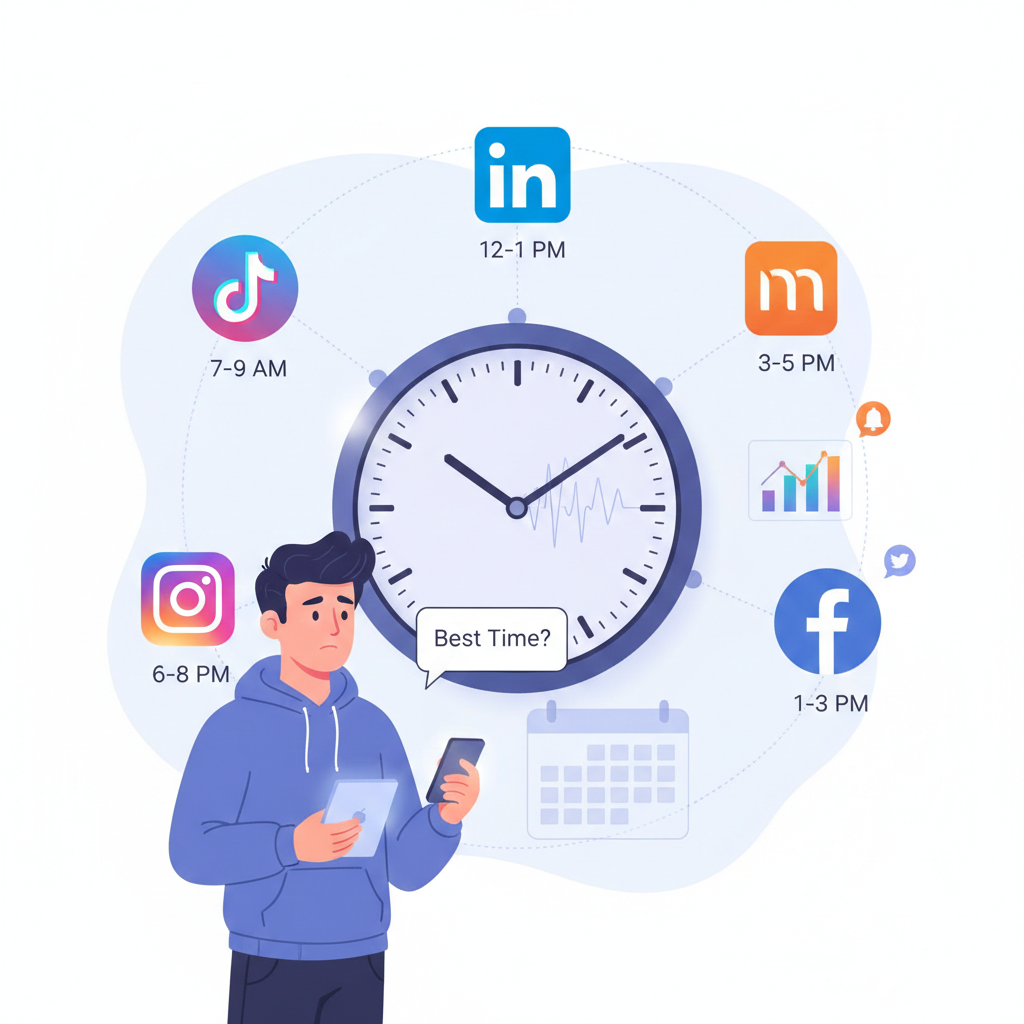
A content creator confused about best time for content marketing

rai: Well, it simply means if you’re guessing posting times. Facebook in the morning, Instagram in the afternoon, and TikTok in the evening.

Posting like that is how things spiral out of control.

It’s also the reason why most campaigns fail. since teams manage multiple platforms separately.

And when you miss the right posting window, leads vanish.

Host: So what is the solution rai?

rai:  Analytics-driven scheduling. Tools that tell you exactly when your audience is awake and scrolling. Less guesswork, more strategy.

Host: That’s new! I’d love to hear more.

Analytics Tools: Measuring What Matters

Host: Okay, so let’s say your posts are live, but how do you know they’re working?

rai: Most content marketers drown in dashboards. Metrics everywhere, clarity nowhere.

Host: Right. So what you are saying is that the key is connected analytics. Like one dashboard that shows what’s performing, why, and what to do next?

rai: Yes. That’s the kind of insight simplecx provides, turning chaos into clear, actionable data.

rai: So instead of exporting reports endlessly, you get the time to decide, act, and optimise. Fast, simple, smart.

Host: That sounds like a plan.

All-in-One Platforms: The Secret to Avoiding Failure

rai: It sure is. Here is the thing: When marketing systems can’t share data, you don’t just lose convenience; you lose visibility, automation efficiency, and cohesive campaign reporting

Therefore, one platform that unifies planning, creation, scheduling, and analytics stops the leaks. Less switching and more flow.

Host: Exactly. That’s why SMEs, startups, and digital creators are turning to all-in-one solutions. simplecx isn’t just another tool.

It’s everything you need for content marketing in one platform.

And right now, when you sign up, you get 400 free credits to explore the platform and see how it fits into your workflow.

So if you’ve been thinking about simplifying your marketing process, this is a great time to take advantage of that early access benefit.
light mode

rai: One dashboard. One login. One place where your campaigns finally breathe.

Host: So, the takeaway?

rai: Stop piling on disconnected apps. Focus on content marketing tools that integrate, automate, and simplify. Don’t let fragmentation make you fail.

Host: Wow, thanks! That’s simple, clear, and actionable.

And yes,  simplecx gives you a head start: faster creation, a consistent voice, and analytics that actually make sense, all from one dashboard.

And to our readers, that’s how you stop digital campaign failure before it even begins.

Host: Before we roll out, here are some quick FAQs from rai.Are we set?

rai: Let’s roll!

rai's FAQ

Q1: Why do campaigns fail often?
A: Most failures happen because marketing tools don’t talk to each other, creating data silos and fragmented workflows.

Q2.How can tools improve efficiency?
A: Integrated tools automate tasks, streamline processes, and keep your content consistent across all channels.

Q3: What makes simplecx different?

A: simplecx combines content creation, design, video, scheduling, and analytics in one dashboard; no app-hopping need

Host: And that’s a wrap. If there’s one thing to take away today, it’s this: campaigns don’t fail because of a lack of effort; they fail when tools slow teams down. 

Simplify your stack, connect your workflows, and let your ideas move faster.
With simplecx, you’re already one step ahead. 

Until next time, keep creating smarter, not harder.

rai: woof!woof!

Best Content Marketing Tools to Prevent Digital Campaign Failure Read More »

Top 5 Ways AI Can Help Your Business Improve Sales

IMG 7404
RAI

How AI is Impacting Businesses, Sales Processes and Results 

Meet Joey, a curious mind with a keen interest in the intersection of technology and business. Eager to learn, Joey has been exploring the myriad ways in which businesses have harnessed the power of artificial intelligence to drive improvement and innovation. Here is his conversation with RAI, Retink’s Artificial Intelligence.

IMG 7406
Curious Joey; Image source: Pixabay

Joey: Hey RAI, I’ve been hearing a lot about AI in business lately. Can you give me a quick rundown of its biggest impacts?

RAI: Absolutely, Joey! AI is revolutionising businesses in several ways. First, it’s transforming customer service. AI-powered chatbots provide 24/7 support, while sentiment analysis helps businesses understand customer feedback in real time.

Joey: That sounds efficient! What’s customer service experience all about?

IMG 7394 2
Customer Experience; image source: Pixabay

RAI: Excellent question! Customer experience (CX) is how customers perceive and interact with a brand, from initial awareness to post-purchase support. It’s the sum of all touchpoints.

Joey: That makes sense. How does AI improve CX?

RAI: AI enhances CX in many ways which include:

  •  Personalisation: AI suggests products based on customer behaviours.
  • Chatbots: AI-powered 24/7 support for queries.
  • Sentiment analysis: AI-monitored feedback for proactive issue resolution. 

Joey: Cool? What about data analytics?

RAI: Another way is through data analysis and insights. AI can process vast amounts of data much faster than humans can. It helps businesses analyse customer behaviour, market trends, and operational efficiencies, allowing them to make informed decisions quickly.

Joey: So, it’s like having a supercharged analyst on the team?

RAI: Exactly! AI’s processing power analyses vast amounts of data, uncovering hidden patterns and insights.

Joey: What kind of insights?

RAI: AI helps businesses;

  • Analyse customer behaviour: purchase history, preferences, and pain points.
  •  Identify market trends: competitor analysis, market shifts, and emerging opportunities.
  • Optimise operational efficiencies: streamlining processes, reducing costs, and enhancing productivity.

Joey: Wow, AI makes data-driven decision-making possible.

RAI: Precisely! AI empowers businesses to:

  • Respond promptly to changing market conditions.
  • Personalise customer experiences.
  • Improve product development.

Joey: What about data visualisation? I’ve seen impressive dashboards.

RAI: AI-driven data visualisation tools create interactive, real-time dashboards, making complex data understandable.

IMG 7395 scaled
Visualised Data; Image source: Pixabay

Joey: That’s fantastic. Are there any examples of companies leveraging AI for data analysis?

RAI: Many! For instance:

  • Netflix uses AI-driven recommendations to personalise content.
  • Amazon employs AI for demand forecasting and supply chain optimisation.
  • Google Analytics utilises AI for website traffic analysis.

Joey: Mind blown! AI’s impact on data analysis is immense.

RAI: Indeed, Joey! AI revolutionises data-driven decision-making.

Joey: Okay, are there more ways?

RAI:  Another way AI improves people’s business is Cybersecurity.

Joey: RAI, how does cybersecurity improve business or sales?

RAI: Excellent question, Joey! Cybersecurity protects businesses from financial losses, reputational damage, and customer trust erosion.

Joey: That makes sense. How does it impact sales?

Secgaps

RAI: This is how AI improves sales by providing insights based on data, identifying new leads, personalising customer experiences

Joey: Wow, I hadn’t thought of that. What are some cybersecurity measures for businesses?

RAI: Cybersecurity measures for businesses include:

  • Firewalls and antivirus software: The financial industry implements this measure by protecting and securing data.
  • Multi-factor authentication: Social media platforms like Facebook, WhatsApp, Instagram use factor authentications to prevent hackers from accessing information. 
  • Regular software updates and patches: This helps to protect devices from security threats, fixes bugs, and improves the performance of the device. 

Joey: What about AI-powered cybersecurity?

RAI: AI-driven cybersecurity helps: 

  • Detects anomalies and threats in real-time
  • Automates incident response
  • Enhances predictive analytics
  • Improves vulnerability management
  • Strengthens endpoint security

Joey: That’s impressive. How do businesses measure cybersecurity effectiveness?

RAI: Most industries (Health, Commerce, Banking, Engineering, and Entertainment) measure cybersecurity effectiveness by calculating how much time lapse between the detection of threats and when appropriate action is taken.

Joey: Thanks, RAI! Cybersecurity is also crucial 

RAI: Absolutely, Joey! Prioritising cybersecurity protects your business, customers, and reputation.

Joey: What’s next?

RAI: AI can automate repetitive tasks, freeing up employees to focus on more strategic work.

Joey: That sounds amazing! Which tasks can be automated?

RAI: Data entry, bookkeeping, customer service, marketing, and more. Any task with predictable patterns.

Joey: What AI technologies enable this automation?

RAI: Machine Learning, Robotic Process Automation, Natural Language Processing, Optical Character Recognition, and Business Process Automation.

Joey: Which industries benefit most from automation?

V-Soft Lab

RAI: Just as in the above video, Manufacturing industries, Finance, healthcare, retail, and logistics. Essentially, any industry with repetitive tasks.

Joey: Wow, impressive! Can you give real-world examples of SMEs that use these automation tasks? 

RAI: In e-commerce, we have Jumia Nigeria, PlentyONE, Konga, and PayPorte. They automate order tracking, inventory management, and customer support.

Joey: That’s convenient. What about finance?

RAI: Interswitch, Penta, Paystack, and RenMoney are leading the way. They automate payment processing, transaction tracking, and loan disbursement.

Joey: Amazing! What about food and beverage?

RAI: Domino’s Pizza Nigeria, Chicken Republic, Burger King. They use digital platforms for online ordering, inventory management, and customer engagement.

Joey: Efficient! Logistics?

RAI: Chowdeck, Hellmann, Jumia Logistics, GIG Logistics, and Glovo.

Joey: These SMEs are innovators! What challenges do they face?

RAI: Infrastructure, funding, regulatory hurdles, and talent acquisition. 

Joey: How do businesses measure automation’s effectiveness?

RAI: They can measure its effectiveness in its ability to complete tasks, reduce errors, also reduce operational costs, reduce logistics costs, and increase customer satisfaction, revenue, and profitability.

Joey: Thanks, RAI! AI automation is a game-changer.

RAI: Absolutely, Joey! AI transforms businesses, making them more efficient and competitive.

Joey: That must save a lot of time and reduce errors!

RAI: Yes, it does!

Joey: Thank you for the insightful conversation. Could you tell me one last way AI has improved sales? 

RAI: Finally,  AI has improved business through predictive analytics. Small and medium-sized enterprises (SMEs) have used predictive analytics to improve their business performance, increase sales, and make better decisions. 

Joey: That’s fascinating, RAI! How does predictive analytics work?

RAI: Predictive analytics uses machine learning algorithms to analyse historical data, identifying patterns and correlations.

Joey: What kind of insights can businesses gain?

RAI: Businesses can strengthen sales using: 

  • Data Crystal Ball; these are data points that reflect the past, and also help predict the future. 
  • Seasonal sales fluctuations; evaluating the impact of past marketing campaigns and tracking changes in customer behaviour.

Joey: Amazing! How does predictive analytics aid decision-making?

RAI: By providing data-driven predictions, businesses can proactively address potential issues, capitalise on emerging opportunities, optimise resource allocation, enhance customer experiences, and improve supply chain efficiency. 

Joey: Which industries benefit from predictive analytics?

RAI: Industries like:

  • Entertainment can narrow target audiences based on demographics and allows the creation of a highly personalised user experience. 
  • Banks provide finance teams with essential analytics tools for sales, expenses, and cash flow to inform financial planning and resource management
  • Hospitals can predict when equipment needs maintenance, which can minimise workflow disruption.
  • Manufacturing industries can use sensors on machinery to predict failures before they happen. It can also identify potential defects before they affect the final product. 

Joey: Can you share some real-world examples?

RAI: Sure!

  • Netflix predicts viewer preferences for personalised content
  • SMEs like Interswitch, RenMoney, and Paystack leverage predictive analytics for revenue forecasting
  • Google predicts search trends for targeted advertising
  • Hospitals predict patient readmission rates for proactive care

Joey: What are the key benefits of predictive analytics?

RAI: Benefits of predictive analysis include: Improving forecast accuracy, enhancing decision-making, increasing efficiency, better risk management, and competitive advantage. 

Joey: Thanks, RAI! Predictive analytics is a powerful tool.

RAI: True, Joey! AI-driven predictive analytics transforms business strategy.

Joey: Wow, that’s impressive! So, AI is changing the game. 

RAI: Absolutely, Joey! From improving customer interactions to streamlining operations, AI is a game-changer for businesses looking to stay competitive in today’s market.

Joey: Thanks, RAI! This gives me a lot to think about for my own business.

RAI: You’re welcome, Joey! You can now Retink your business operations using AI-related services. To get started, book a consultation call with Retink’s team of AI experts here.

Related Posts

TOP 10 Ways AI is Transforming Businesses

Beginner Tips for Using AI Tools in Business

Top 5 Ways AI Can Help Your Business Improve Sales Read More »

BEGINNER TIPS FOR USING AI TOOLS IN BUSINESS

Introduction to AI in Business

16 1
Retink’s AI

Yele, a shoemaker, has just received an annual grant from Microcheap. He’s excited to promote his products and services, but there’s one problem, he’s never sold online before. His sister, Tawa, suggests using social media to reach a broader audience. To help her brother navigate this new territory, Tawa turns to Retink’s AI, RAI, for guidance.

Here is a conversation between Tawa and RAI: 

IMG 6226


Tawa: Hello RAI! My brother Yele just got a grant from Microcheap. He’s a shoemaker and wants to promote his business online.

RAI: Congrats to Yele! That’s awesome. What does he need help with?

Tawa: He’s never sold online before. I told him about social media, but I want to ensure he does it right.

RAI: Smart move! Let’s break it down. First, Yele needs high-quality product images showcasing his shoes from different angles, writing product descriptions, and scheduled posts. 

Tawa: Is there a more efficient way of handling his online presence, what about online tools that may be of help?

RAI: Absolutely! AI-powered tools can help Yele streamline everything, from content creation to customer engagement. 

AI Tools for Small Business Owners


Tawa
: So, what  AI tools would you recommend for Yele’s shoe business?

RAI: Awesome question, Tawa! For Yele’s business, he could start with content creation tools like WordLift, Canva, or Lumen5.

Tawa: Why those?

00905A8A 6DF4 42AF BFB2 5DBDECDDAC75 e1729758591177

RAI: WordLift helps with writing engaging product descriptions, Canva offers AI-driven design suggestions for visuals, and Lumen5 creates stunning videos showcasing his shoes.

Tawa: That’s great! What about managing his social media presence?

RAI: Hootsuite Insights, Buffer, or Sprout Social are excellent choices. They help with predictive analytics, content optimization, and customer service.

Tawa: How can he make his products stand out online?

RAI: Adobe Dimension or Sketchfab can create 3D designs and models, making his products stand out online.

Tawa: Wow, that’s impressive! What about customer engagement?


Boosting Sales with AI-Powered E-commerce Tools


RAI: ManyChat or Freshdesk can automate customer support and improve the overall experience.

Tawa: SEMrush, Ahrefs, or Google Analytics for SEO and analytics?

RAI: Exactly! Those tools provide valuable insights for keyword research, backlink analysis, and predictive analytics.

Tawa: How about e-commerce integration?

RAI: Shopify or WooCommerce offers AI-powered product recommendations and sales analytics to boost online sales.

Tawa: Thanks, how should he get started? 

RAI: Excellent question! Here’s a step-by-step guide to help Yele; 

  • Definition of his goals– Identify business objectives; either to increase online sales or enhance customer engagement.
  • Choose AI tools– Research beginner-friendly tools that align with his goals.
  • Learn the basics– Watch tutorials and take online courses, read blog posts, and join communities and forums. 
  • Experiment– Test AI tools with small projects.
  • Integrate AI Tools– Connect AI tools to existing workflows.
  • Monitor performance– Track key metrics (engagement, sales)


Overcoming Challenges When Using AI


Tawa: What challenges might Yele face while using AI?

RAI: Great question, Tawa! Yele might encounter technical issues like integration problems, data quality concerns, or security risks.

Tawa: That’s worrying. What about non-technical challenges?

RAI: Well, there’s the learning curve, cost, and time commitment. Plus, ensuring AI-driven decisions are unbiased and align with business values.

Tawa: I see. Are there any content-specific challenges?

RAI: Content quality, consistency, and originality are crucial. AI-generated content must meet Yele’s standards.

Tawa: RAI, what do you mean by content quality, consistency, and originality?

RAI: When using AI tools for content creation, Yele needs to ensure:

  • Quality: AI-generated content is well-written, informative, and engaging.
  • Consistency: AI-driven content aligns with Yele’s brand voice, tone, and style.
  • Originality: AI-generated content is unique, avoiding duplication or plagiarism.

Tawa: Why is this important?

RAI: High-quality, consistent, and original content builds trust with customers, enhances brand reputation, Improves search engine rankings, and drives engagement and conversions. 

Tawa: How can Yele ensure this?

RAI: He should: 

  • Review and edit AI-generated content
  • Set clear guidelines for AI tools
  • Use AI tools that prioritise quality and originality
  • Monitor content performance and adjust


Tawa: So you mean he still has control over AI-generated content?

RAI: Absolutely! 


Turning AI Data Into Actionable Insights

Tawa: That makes sense, how can Yele interpret AI-driven analytics and insights?

RAI: He should focus on data overload, interpretation, and actionability can be tricky. Yele needs to understand AI-driven insights and turn them into actionable decisions.

Tawa: How can he make sense of AI-driven insights?

RAI: I get it, Tawa! AI tools can generate vast amounts of data. To overcome this, Yele needs to focus on:

  • Clear Goals: Identify what he wants to achieve with the data.
  • Data Visualization: Use dashboards and charts to make sense of the data.
  • Key Metrics: Pay attention to metrics that align with his goals.
  • Expert Guidance: Seek help from AI experts when needed.

Tawa: That’s helpful! What about making these insights actionable?

RAI: Good question! Yele should:

  • Prioritise insights: Focus on the most impactful findings.
  • Create action plans: Develop concrete steps based on insights.
  • Assign tasks: Delegate responsibilities to team members.
  • Track progress: Monitor the effectiveness of actions.
  • Refine strategy: Continuously adjust based on new insights.


Improving Customer Service with AI


Tawa: What about Customer engagement?

RAI: Tools like ManyChat and Freshdesk, can automate customer support, providing quick and efficient services.


Overcoming AI-driven tools challenges 


Tawa: Thanks, RAI! How can Yele overcome these challenges?

RAI: He can overcome these challenges by consulting experts, investing in training, starting small, monitoring performance, and staying updated on AI advancements.

Tawa: That’s all the questions I have for now, RAI. Thanks for the insights, You’ve been incredibly helpful. I think Yele’s got a great starting point for his AI journey.

RAI: My pleasure, Tawa! Tell Yele that AI is a tool to enhance human creativity and efficiency, not replace it. Good luck with his business journey!

Tawa: Thank you! I would

RAI: Great! Many others like Yele can use Retink Media’s consultation services. Here

00905A8A 6DF4 42AF BFB2 5DBDECDDAC75 e1729758591177

BEGINNER TIPS FOR USING AI TOOLS IN BUSINESS Read More »